
Every year, the food industry produces large amounts of fruit and vegetable waste. Peels, seeds, pulp, stems, and other by-products often end up as waste. However, these materials can contain valuable compounds such as antioxidants, natural pigments, flavors, and dietary fibers.
Instead of throwing these resources away, researchers are looking for ways to reuse them. One promising approach uses lactic acid bacteria (LAB) and fermentation. This method could help turn food by-products into useful resources while supporting a more sustainable food system.
A Circular Economy Approach to Food Waste
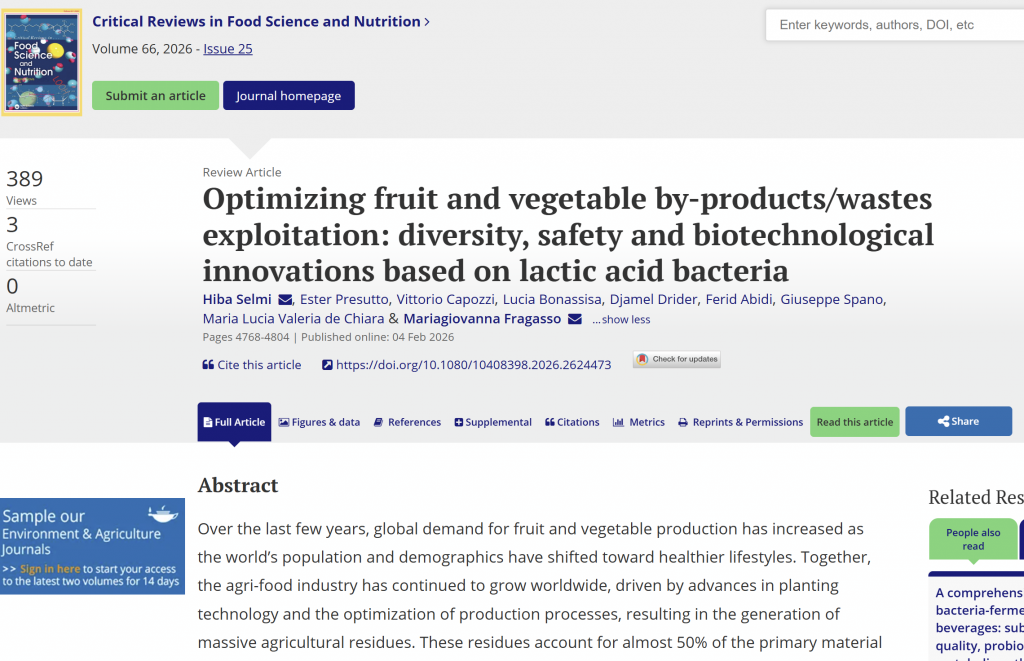
A recent review by Hiba Selmi, Ester Presutto, Vittorio Capozzi, Lucia Bonassisa, Djamel Drider, Ferid Abidi, Giuseppe Spano, Maria Lucia Valeria de Chiara, and Mariagiovanna Fragasso explores new ways to valorize fruit and vegetable by-products.
The review focuses on the use of lactic acid bacteria for food waste valorization. It also looks at safety, regulations, seasonality, and recent biotechnology developments.
The researchers ask an important question: How can we turn food waste into valuable resources while keeping the process safe and sustainable?
Why Are Fruit and Vegetable By-Products Valuable?
Fruit and vegetable processing creates a large amount of residual biomass. In fact, these residues can account for almost 50% of the primary material biomass.
More importantly, they can contain many valuable compounds, including:
- Antioxidants that can support food quality and preservation
- Dietary fibers with nutritional and functional benefits
- Natural pigments that can provide color for food and other products
- Flavors and other bioactive compounds
- Other components with potential uses in food and biotechnology
Therefore, these materials may offer much more value than their traditional role as waste.
Lactic Acid Bacteria as a Natural Tool
The review highlights lactic fermentation as a promising way to process fruit and vegetable by-products.
Lactic acid bacteria have long played an important role in food fermentation. During fermentation, these microorganisms transform different components of the food material. As a result, they can create desirable changes in its properties.
Furthermore, fermentation can provide a relatively simple and low-cost way to process some food residues. This makes LAB an interesting tool for connecting food waste valorization, fermentation, and the circular economy.
Safety Comes First
However, food waste valorization also brings important challenges.
Fruit and vegetable by-products may contain different contaminants. For this reason, researchers need to carefully assess their safety before using them in new applications.
The review examines several key factors:
- The different types of fruit and vegetable by-products
- Seasonal changes in agricultural production
- How food processing generates different residues
- Potential biological and chemical contaminants
- Food safety requirements
- Regulatory considerations
- The use of LAB for safe and effective valorization
These factors can help researchers choose the right processing methods for each type of by-product.
From Food Waste to New Opportunities
The review shows that fruit and vegetable by-products can become valuable resources instead of simple waste.
Through fermentation and other biotechnological approaches, researchers can explore new uses for these materials. These uses may include food ingredients, bioactive compounds, and other sustainable products.
At the same time, better use of these resources can help reduce waste and environmental impacts. It can also support the development of more circular food production systems.
What Does This Mean for Sustainable Packaging?
This research has strong links with the work of INTACTBioPACK.
Fruit and vegetable by-products can provide potential sources of bioactive compounds and functional ingredients. Researchers can explore these resources for applications in sustainable food packaging.
At INTACTBioPACK, we are exploring how biotechnology and microbiome-based solutions can support the development of active, intelligent, and biodegradable packaging for Mediterranean food products.
In this context, food waste could become part of the solution. Instead of treating agricultural residues as waste, we can explore ways to recover their valuable components and use them in new sustainable applications.
Ultimately, combining lactic acid bacteria, food waste valorization, and circular economy principles could help create more sustainable food systems.
To learn more about research related to sustainable and active food packaging, visit the INTACTBioPACK research page.
Reference: Selmi, H., Presutto, E., Capozzi, V., Bonassisa, L., Drider, D., Abidi, F., Spano, G., de Chiara, M. L. V., & Fragasso, M. Optimizing fruit and vegetable by-products/wastes exploitation: diversity, safety and biotechnological innovations based on lactic acid bacteria. Critical Reviews in Food Science and Nutrition, 66(25), 4768–4804. Published online 4 February 2026. Read the full article here


