
Food packaging must protect products from oxygen, carbon dioxide, moisture, and other factors that can reduce quality and shorten shelf life. Today, materials such as polypropylene (PP) are widely used for this purpose. However, the environmental impact of petroleum-based plastics is driving research into bio-based and biodegradable packaging materials.
One promising material is polyhydroxybutyrate-co-valerate (PHBV), a biodegradable polymer that could offer an alternative to conventional plastic packaging.
Researchers Test PHBV for Cheese Packaging
A research team from IATE at the University of Montpellier, INRAE, Institut Agro, and CIRAD in France investigated whether PHBV cups could provide the barrier performance needed for food packaging.
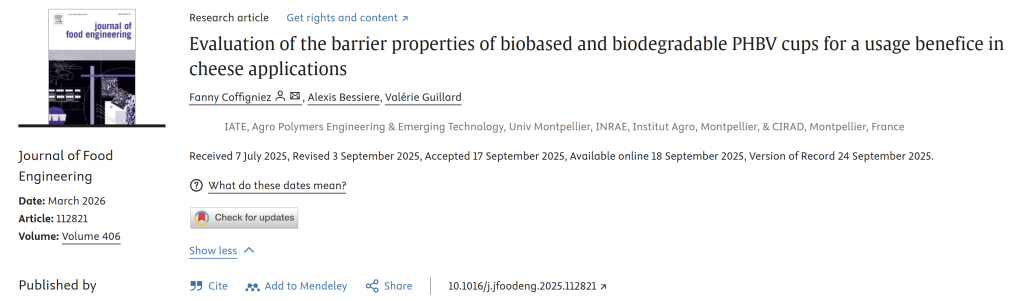
Fanny Coffigniez, Alexis Bessiere, and Valérie Guillard studied PHBV cups with and without natural fibers. The team compared pure PHBV with cups containing 20% cellulose fibers or 20% wood fibers.
The main goal was to determine whether these bio-based and biodegradable cups could replace conventional polypropylene packaging while maintaining food quality and shelf life.
Why Are Barrier Properties Important?
Packaging needs to control the movement of gases between the food and the surrounding environment. This is especially important for foods stored under modified atmosphere packaging (MAP).
MAP replaces the air inside a package with a controlled gas mixture. The right balance of oxygen and carbon dioxide can help slow food deterioration and extend shelf life.
For this reason, researchers measured how easily oxygen (O₂) and carbon dioxide (CO₂) passed through the different PHBV packaging materials.
Pure PHBV Shows Promising Performance
The results showed that pure PHBV cups had barrier properties similar to polypropylene (PP).
This is an important finding because it suggests that PHBV could provide the protection needed for certain food applications while offering the benefits of a bio-based and biodegradable material.
The researchers also used 2D numerical simulations to study how the packaging could affect the gas composition inside the package and, ultimately, food preservation.
What Happens When Natural Fibers Are Added?
The study also tested PHBV cups containing 20% natural fibers.
However, the addition of fibers created a major challenge. The fibers caused fractures and small holes in the cups. These defects made it easier for gases to pass through the packaging.
As a result:
- Oxygen permeability increased by 11 to 23 times.
- Carbon dioxide permeability increased by 5 to 10 times.
- The fiber-containing cups showed greater embrittlement and structural damage.
These results show that adding natural fibers can change the barrier performance of PHBV packaging. Therefore, researchers need to carefully control the material structure when developing fiber-reinforced biodegradable packaging.
PHBV and Modified Atmosphere Packaging
Despite the challenges with fiber-reinforced PHBV, the results for pure PHBV cups were encouraging.
The numerical simulations showed that PHBV cups could potentially replace PP packaging for products stored under modified atmosphere conditions.
In particular, the researchers found that PHBV cups could provide a similar shelf life to commercial packaging for products with an intermediate shelf life, such as fresh cheese.
This finding is important because it moves biodegradable packaging beyond laboratory testing and toward real food applications.
What Does This Mean for Sustainable Packaging?
The study demonstrates that bio-based and biodegradable PHBV packaging can provide barrier properties suitable for specific food applications.
At the same time, the results highlight the importance of material design. Adding natural fibers does not automatically improve packaging performance. Researchers must consider how fibers affect the structure, strength, and gas barrier properties of the final material.
For INTACTBioPACK, this research is particularly relevant. The project focuses on developing biodegradable and functional packaging solutions for Mediterranean food products.
Research on PHBV helps demonstrate how bio-based materials can replace conventional plastics while maintaining the performance needed for food preservation. Combined with active and intelligent packaging technologies, these materials could contribute to the next generation of more sustainable food packaging.
The study therefore provides valuable evidence that biodegradable packaging can deliver both environmental and functional benefits, helping support the transition away from petroleum-based plastics.
To learn more about research related to sustainable and active food packaging, visit the INTACTBioPACK research page.
Reference: Coffigniez, F., Bessiere, A., & Guillard, V. Evaluation of the barrier properties of biobased and biodegradable PHBV cups for a usage benefice in cheese applications. Journal of Food Engineering. Available online 18 September 2025. Read the full article here


