
Food packaging plays an important role in protecting food from microbial spoilage and extending shelf life. However, conventional plastic packaging raises growing environmental concerns, creating a need for more sustainable and functional alternatives. Active packaging, particularly packaging with antimicrobial properties, is emerging as a promising solution to improve food safety while reducing food waste.
A New Approach Using Probiotics and Postbiotics
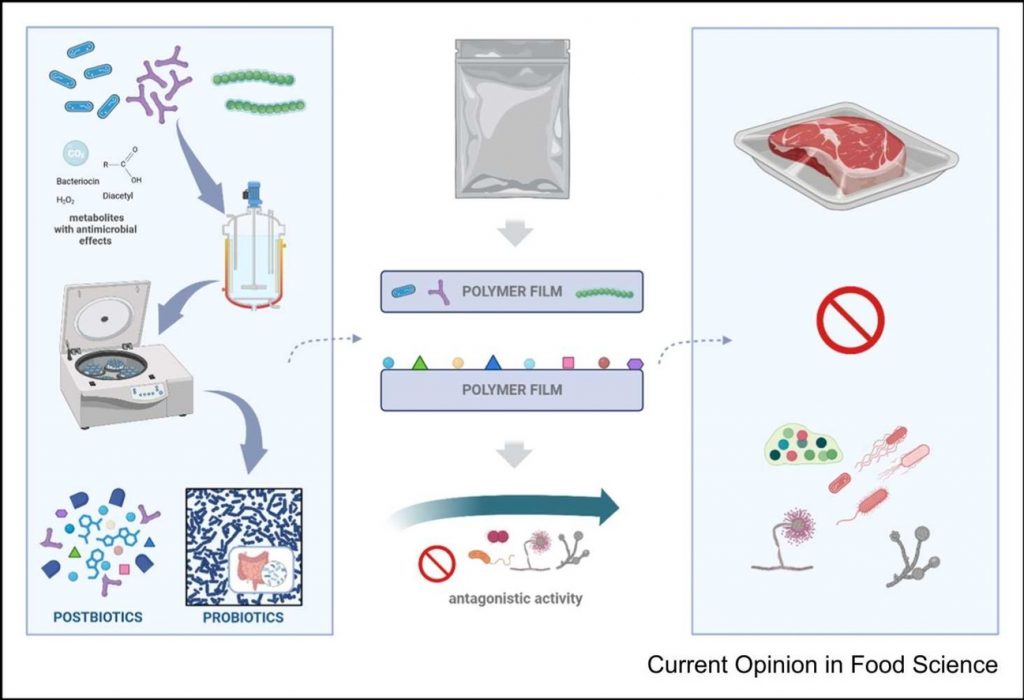
A recent review by Nour MH Awad, Vittorio Capozzi, Valérie Guillard, and Gulden Goksen explores the latest developments in probiotic- and postbiotic-based antimicrobial packaging systems. The study examines how beneficial microorganisms and their bioactive components can be incorporated into packaging materials to help control harmful and spoilage microorganisms.
The approach combines the advantages of active packaging with the antimicrobial potential of selected microorganisms, offering new possibilities for sustainable food preservation.
How Do Probiotics and Postbiotics Work?
Probiotics are live microorganisms that can provide health benefits when consumed in adequate amounts. Certain probiotic microorganisms, particularly lactic acid bacteria (LAB), can produce compounds such as lactic acid, acetic acid, bacteriocins, and hydrogen peroxide that can inhibit unwanted microorganisms.
However, using live microorganisms in packaging can be challenging. They are sensitive to factors such as temperature, pH, processing conditions, and storage, making it difficult to maintain their viability throughout the packaging’s lifetime.
This is where postbiotics offer an interesting alternative. Postbiotics are preparations containing inanimate microorganisms or their components that can retain beneficial biological activities. They can include microbial cell components and compounds such as organic acids, bacteriocins, enzymes, and other metabolites with antimicrobial potential.
Key Findings: From Microbial Activity to Active Packaging
The review highlights several important factors that determine the performance of probiotic- and postbiotic-based antimicrobial packaging:
- Antimicrobial activity: Selected microorganisms and their metabolites can inhibit spoilage microorganisms and foodborne pathogens.
- Shelf-life extension: Antimicrobial packaging systems can help slow microbial deterioration and potentially extend food shelf life.
- Food safety: Several studies have demonstrated reductions in important foodborne pathogens, supporting the potential of these systems for safer food products.
- Packaging structure: Mechanical, structural, and barrier properties influence how effectively antimicrobial components perform within packaging materials.
- Stability: Maintaining the activity or viability of probiotic-based systems during processing and storage remains an important challenge.
- Food applications: Research has explored these systems in different food models, demonstrating their potential for practical food preservation applications.
Why Postbiotics Could Be Particularly Promising
One of the most interesting developments highlighted by the review is the increasing attention toward postbiotic-based packaging. Unlike probiotics, postbiotics do not depend on maintaining living microorganisms within the packaging material.
This could make them easier to incorporate into packaging systems while maintaining antimicrobial functionality. Their use could therefore help overcome some of the stability challenges associated with probiotic-based active packaging.
Toward More Sustainable Food Packaging
The development of antimicrobial packaging based on probiotics and postbiotics represents an important step toward smarter, more sustainable food preservation. By helping control microbial spoilage and foodborne pathogens, these systems could contribute to longer shelf life, improved food safety, and ultimately reduced food waste.
The review also emphasizes that further research is needed to improve the stability, safety, formulation, and large-scale application of these innovative packaging systems.
This research is highly relevant to INTACTBioPACK’s mission to develop intelligent, active, biodegradable, and microbiome-based packaging solutions for Mediterranean food products. Understanding how beneficial microorganisms and their bioactive compounds can be integrated into packaging provides valuable scientific foundations for developing next-generation packaging that does more than simply protect food; it can actively contribute to its preservation.
To learn more about research related to sustainable and active food packaging, visit the INTACTBioPACK research page.
Reference: Awad, N. M. H., Capozzi, V., Guillard, V., & Goksen, G. An innovative approach for probiotics- and postbiotics-based antimicrobial packaging systems: design, characterization, and benefit for food application. Current Opinion in Food Science. 2025, 101315. Read the full article here


