
How can food packaging tell us when a product is starting to lose its freshness?
Researchers are developing intelligent food packaging that can provide this information through visible changes. A recent study presents a biodegradable hydrogel film that changes color when the pH of its environment changes. This could give consumers a simple way to monitor food freshness directly from the package.
A New Intelligent Packaging Film
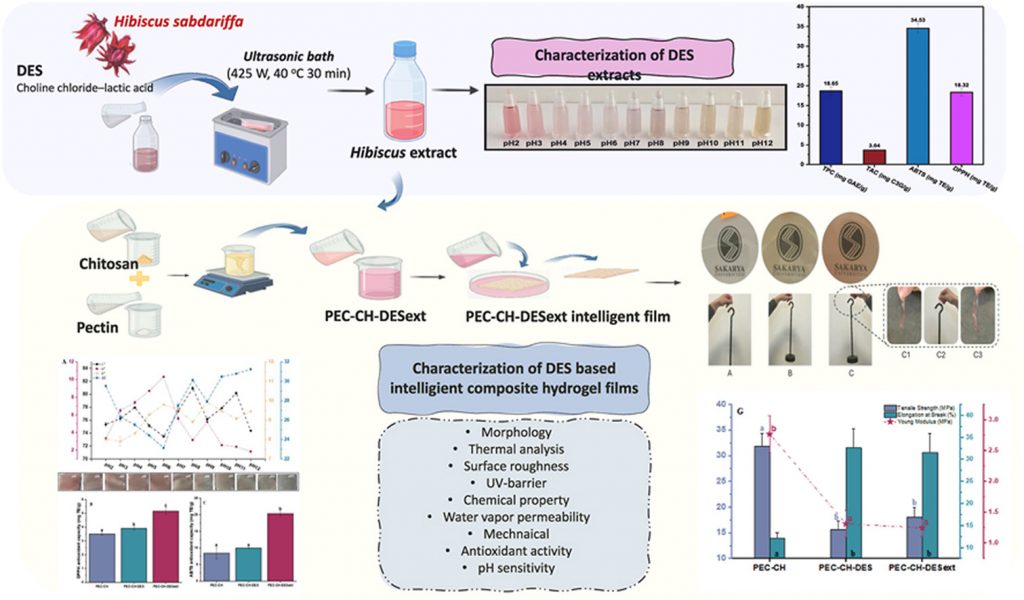
Researchers Hamza Alasalvar, Gulsah Karabulut, and Gulden Goksen developed a new film based on pectin and chitosan, two biopolymer materials that can support biodegradable packaging applications.
The researchers added two natural ingredients to improve the film:
- Hibiscus sabdariffa extract, which contains anthocyanins and antioxidant compounds
- A natural deep eutectic solvent (DES) made from choline chloride and lactic acid
Together, these components created a multifunctional film with pH responsiveness, antioxidant activity, flexibility, and biodegradability.
How Does the Film Detect Freshness?
One of the most interesting features of the film is its ability to change color in response to pH.
The anthocyanins from the hibiscus extract act as natural color indicators. As the pH changes, the film can shift through different colors:
Red → Purple → Yellow
This visible response could help consumers monitor changes in food quality without opening the package.
For example, as perishable food products deteriorate, microbial and chemical reactions can change the conditions inside the package. A pH-responsive indicator could detect these changes and provide a simple visual signal.
Natural Ingredients Add More Functionality
The hibiscus extract does more than provide color.
The researchers found that it also increased the film’s antioxidant activity. Tests using DPPH and ABTS methods showed improved antioxidant performance after adding the extract.
This could provide an additional benefit for food packaging. Antioxidant properties may help limit oxidation, which can affect food quality, flavor, and shelf life.
Therefore, the film combines two useful functions:
Freshness indication + antioxidant activity
A More Flexible Packaging Material
The natural deep eutectic solvent also changed the mechanical properties of the film.
The DES increased the film’s flexibility, allowing it to stretch more before breaking. However, this improvement came with a reduction in tensile strength.
The researchers linked these changes to modifications in the interactions between the polymer chains. The film developed a more disordered structure, which allowed the chains to move more easily.
In simple terms, the DES helped make the material more flexible and easier to handle.
One Important Challenge: Water Barrier Performance
The study also identified a limitation.
Adding the natural deep eutectic solvent increased water vapor permeability by 194%. This means that the film allowed much more water vapor to pass through it.
Water vapor control is important in food packaging because moisture transfer can affect food texture, quality, and shelf life.
Therefore, future research will need to improve the film’s moisture barrier while maintaining its color response, antioxidant activity, and flexibility.
Toward Smarter and More Sustainable Food Packaging
Despite this challenge, the results show strong potential for biodegradable intelligent food packaging.
The pectin-chitosan hydrogel film combines several functions in one material:
- pH-responsive color change
- Freshness monitoring
- Antioxidant activity
- Mechanical flexibility
- Biodegradable biopolymer components
- Potential for direct contact with perishable foods
This multifunctional approach could help move food packaging beyond simply protecting products. Instead, packaging could also communicate information about food quality to consumers.
Why Is This Research Relevant to INTACTBioPACK?
This study closely connects with the goals of INTACTBioPACK, particularly the development of intelligent and sustainable packaging solutions for Mediterranean food products.
Natural compounds such as hibiscus anthocyanins can provide useful sensing functions without relying on synthetic color indicators. At the same time, biopolymers such as pectin and chitosan offer opportunities for developing more sustainable packaging materials.
The research also demonstrates an important principle for next-generation packaging: one material can perform several functions at the same time.
A biodegradable package could protect food, respond to changes in food quality, and provide consumers with an easy-to-understand visual signal.
As research continues, combining biodegradable materials, natural bioactive compounds, and intelligent indicators could help create food packaging that is not only more sustainable but also more informative and functional.
Reference: Alasalvar, H., Karabulut, G., & Goksen, G. Natural deep eutectic solvent-based pectin-chitosan composite hydrogel films: A novel pH-responsive color indicator for food packaging systems. Current Research in Food Science. 2025 For a complete view of the data


